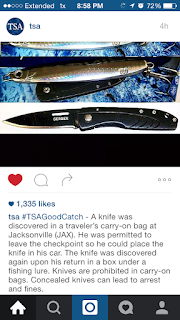
Here's a
screenshot of my favorite recent post on the @TSA Instagram account. Hope you
laugh as hard as I did!
For those as interested in the TSA as I am, here's a quiz to see how much you know.
Showing posts with label Social Media. Show all posts
Wednesday, September 16, 2015
Thursday, January 22, 2015
Request your LinkedIn Archive
Still unbeknownst to how this happened, I got on the distribution list for iBlog magazine and read through it on the train this past week.
The most valuable piece I came across in this month's issue focused on the importance of social networking and networking online. The article shared that LinkedIn lets you request an archive of your data in Excel form, and guarantees to send you this information within 72 hours of requesting it.
Here's how:
1. Go to your Privacy & Settings section (on the far right under the Account/Settings link)
2. Click on the Account tab not he bottom left side
3. Click on the "Request an archive of your data" link your network.
I tested it out and within 24 hours, received a .zip file of nearly 12 .csv Excel files with various groupings of data: all of my connections, email addresses, skills, search queries, ads I've clicked on, my ad targeting profile and more. It can't hurt to have an Excel file of all your LinkedIn contacts. Think of all the filtering and pivoting you can do by company, school and more! (Nerd alert). Overall, nothing was incredible or fascinating about the archive, but it helps me feel like I own the information I share eon the Internet. Check yours out!
The most valuable piece I came across in this month's issue focused on the importance of social networking and networking online. The article shared that LinkedIn lets you request an archive of your data in Excel form, and guarantees to send you this information within 72 hours of requesting it.
Here's how:
1. Go to your Privacy & Settings section (on the far right under the Account/Settings link)
2. Click on the Account tab not he bottom left side
3. Click on the "Request an archive of your data" link your network.
I tested it out and within 24 hours, received a .zip file of nearly 12 .csv Excel files with various groupings of data: all of my connections, email addresses, skills, search queries, ads I've clicked on, my ad targeting profile and more. It can't hurt to have an Excel file of all your LinkedIn contacts. Think of all the filtering and pivoting you can do by company, school and more! (Nerd alert). Overall, nothing was incredible or fascinating about the archive, but it helps me feel like I own the information I share eon the Internet. Check yours out!
Wednesday, October 8, 2014
Facebook phone search
Online tip of the day!
Did you know that if you type in a cellphone number into the Facebook search bar, the person's profile will come up?
At first, we thought this was only possible if you had your cellphone number publicly posted on your profile, but the profile comes up regardless. It worked for all of my friends' numbers who I typed in, and when someone I am not Facebook friends with was searched, they came up along with our mutual friends. Creepy! No guarantees that it will work for everyone, but definitely something to test.
We can't prove this, but my coworker and I think that this is because of the Messenger app. Guess there IS a reason everyone needs to have the app to be able to read your messages...data collection. Looks like Facebook might become the new phone book. Give it a shot!
Did you know that if you type in a cellphone number into the Facebook search bar, the person's profile will come up?
At first, we thought this was only possible if you had your cellphone number publicly posted on your profile, but the profile comes up regardless. It worked for all of my friends' numbers who I typed in, and when someone I am not Facebook friends with was searched, they came up along with our mutual friends. Creepy! No guarantees that it will work for everyone, but definitely something to test.
We can't prove this, but my coworker and I think that this is because of the Messenger app. Guess there IS a reason everyone needs to have the app to be able to read your messages...data collection. Looks like Facebook might become the new phone book. Give it a shot!
Friday, September 19, 2014
Word of the day
Nomophobia: Fear of being out of mobile phone contact
Think: NO-MO-bile phobia.
Read more in Business Insider here.
Think: NO-MO-bile phobia.
Read more in Business Insider here.
Wednesday, September 10, 2014
Importance of catching up
I saw this picture hanging up at a co-worker's desk last week. Magazine ads are always powerful, but this one was particularly notable and ahead of its time.
Turning the print advertisement around, it's an ad for Visit North Carolina in 2009, but carries on a different meaning now than it probably would have then.
Wisdom is realizing that catching up is more important than keeping up.
In a world of constant updates & social media, it was a great reminder that you don't have to keep up with everyone's online statuses, photos, etc. But when you see them in person, talk on the phone or talk in detail, you can hear those things then.
Turning the print advertisement around, it's an ad for Visit North Carolina in 2009, but carries on a different meaning now than it probably would have then.
Wisdom is realizing that catching up is more important than keeping up.
In a world of constant updates & social media, it was a great reminder that you don't have to keep up with everyone's online statuses, photos, etc. But when you see them in person, talk on the phone or talk in detail, you can hear those things then.
Monday, August 11, 2014
Generation Like
Check out this Frontline documentary titled Generation Like.
It's definitely geared toward people who work in marketing and market research, particularly with brands focused on acquiring young adults and children. Despite the media jargon, it still teaches you a lot about our generation and motivations online. Enjoy!
Wednesday, April 30, 2014
Instagram woes
A text from a friend, re: liking her Instagram photo. It's all about 11 likes!
Learn what else works on Instagram with this Mashable chart.
Tuesday, April 29, 2014
Facebook photos
Thursday, April 3, 2014
More Snapchat secrets
I called out some Snapchat secrets back in October, but as the updates continue, there is always more to learn.
My general perspective on Snapchat stories is that they are not necessary. If I wanted you to see the Snapchat, I would send it to you directly. Since stories were rolled out later, most of my friends that post them downloaded the app after stories were released, so it's easy to tell who the "newbies" are. Plus, they just seem like a photo Facebook status.
While some friends were over for dinner the other night, we were group-Snapchatting some people that weren't there and complaining about stories. Much to my surprise (and scare), I learned that when you post a Snapchat story, you can see who looks at it! I thought this was creepy, because it's like getting a list of everyone who has "seen" your Facebook posts. In addition, I don't like push notifications and clutter, so I often clear out my Snapchat stories (regardless of who sent them) so they don't show up under recent updates. I'm not friends with anyone on Snapchat who I would actually be embarrassed in front of if they knew I watched their "stories," but still wasn't too keen on the concept.
I decided to "research" this firsthand by posting a story or two myself and see how exactly this works:
My original expectation was that maybe 10 people view these, but I quickly saw that many other people do what I do and clear them out. More than 60 people watched each Snap in 24 hours, which is the majority of my Snapchat contact list. It honestly was an irrational self-esteem boost to think that that many people cared about clicking on it, but placing myself in the situation...I don't always care about the ones I am passively 'watching.' I'm still curious behind the motivations to post a story, but now we all know about this list of those who viewed!
My general perspective on Snapchat stories is that they are not necessary. If I wanted you to see the Snapchat, I would send it to you directly. Since stories were rolled out later, most of my friends that post them downloaded the app after stories were released, so it's easy to tell who the "newbies" are. Plus, they just seem like a photo Facebook status.
While some friends were over for dinner the other night, we were group-Snapchatting some people that weren't there and complaining about stories. Much to my surprise (and scare), I learned that when you post a Snapchat story, you can see who looks at it! I thought this was creepy, because it's like getting a list of everyone who has "seen" your Facebook posts. In addition, I don't like push notifications and clutter, so I often clear out my Snapchat stories (regardless of who sent them) so they don't show up under recent updates. I'm not friends with anyone on Snapchat who I would actually be embarrassed in front of if they knew I watched their "stories," but still wasn't too keen on the concept.
I decided to "research" this firsthand by posting a story or two myself and see how exactly this works:
| You click on your own name, see your score and 'best friends,' and then any stories you have posted with the number of eyeballs who have seen it. Then, click the story to see who has viewed. |
| Under the "story," which was about it being warm enough to bike outside, this is what appears when you click to see the list of everyone who saw it. |
Sunday, March 30, 2014
What I've learned from taking a break from the book
Sitting in the back seat on Facebook these past few weeks, here are a few things I have learned:
1. People
give themselves a lot more credit for what they post than they deserve.
I've been in multiple conversations lately where someone is describing a weekend outing or situation, and they have actually said, "You probably saw the picture on Facebook." With complete confidence. Maybe I am biased as I have a large Facebook community, but I would never assume that someone sees each of my posts on Facebook, especially with how targeted the news feed is these days. Staying off of it shows me how much people rely on posting as a means to share their whereabouts, rather than actually sharing news aloud.
2. Facebook is integral for learning about others' relationship statuses.
While Facebook's status updates are a key way to hear relationship news, clearly it can't be that important to your day-to-day life because if you were really close with someone, you'd hear about their "official" boyfriend/girlfriend status or engagement from them. That being said, I've missed plenty of relationship news shying away from Facebook, and heard about engagements through friends telling me the news or through ring photos on social platforms with more intimate communities, like Instagram. Because this is a "status update" that isn't an option on other platforms, it's most prevalent and frequently updated on Facebook.
3. We have plenty of other outlets to communicate.
Not logging onto Facebook every few hours has taught me how many other communication outlets are accessible to reach others. If I want to reach out to someone in the digital space or send them an article, I can text, email or tweet at them instantly. All of those options exist to share photos too. Facebook only dominates if you let it.
While Facebook's status updates are a key way to hear relationship news, clearly it can't be that important to your day-to-day life because if you were really close with someone, you'd hear about their "official" boyfriend/girlfriend status or engagement from them. That being said, I've missed plenty of relationship news shying away from Facebook, and heard about engagements through friends telling me the news or through ring photos on social platforms with more intimate communities, like Instagram. Because this is a "status update" that isn't an option on other platforms, it's most prevalent and frequently updated on Facebook.
3. We have plenty of other outlets to communicate.
Not logging onto Facebook every few hours has taught me how many other communication outlets are accessible to reach others. If I want to reach out to someone in the digital space or send them an article, I can text, email or tweet at them instantly. All of those options exist to share photos too. Facebook only dominates if you let it.
Thursday, March 27, 2014
Instagram photo map
The Instagram photo map has to be my favorite social media feature right now. Creating it provides an incentive to geo-tag photos, and it creates this beautiful map showing all the territory you have conquered!
| Instagram photo map: Chicago area. Clearly I'm lacking on the South Side. |
Restaurants and destinations win because their locations look more popular on social media. FourSquare wins because they are getting checkins. Instagram wins because you're uploading photos, and you win because it makes this super cool map. I look at the photo map as digital scrapbooking, a simple visual showing where you have been and identifying what else there is to try. Try it out!
| The Loop - River North border on the photo map |
Tuesday, March 25, 2014
Ancient Internet stories
The other day in a training session at work, an executive at my company said, "And in 1996, clients would ask, 'What are we going to do on the Internet? There's nobody there.'"
That sparked all of the stories from our youth of the Internet being new and exciting. Remember….
There are countless memories. What other ancient Internet stories come to mind?
That sparked all of the stories from our youth of the Internet being new and exciting. Remember….
- In elementary/middle school when everyone had a dial-up connection?
- How you could practically do a dance while the computer was connecting to the Internet?
- When everyone was on AOL Instant Messenger until the wee hours of the night?
- When your house could have a computer without Internet on it and it wouldn't be a big deal?
There are countless memories. What other ancient Internet stories come to mind?
Sunday, March 23, 2014
Social media flirting
Life growing up in your 20s as digital natives: where this is a normal conversation to have with friends.
Saturday, February 15, 2014
Lines of communication
Think about how many modes of communication we have today:
Planning a career fair and other events at Mizzou, being in the corporate world and even making social plans, there is nothing more frustrating than the amount of communication methods we have. Ten years ago if you were planning an event or scheduling something, you would ask someone if they could come, they would look at their calendar while you had them in your office or on the phone and would answer "Yes, I'll be there." or "No, I can't." But with the respond-as-you-can method of email, and text messages for constant updates, people can wait until the last minute to make decisions.
We spend time contemplating how to best reach someone - which account they will check, or where your message will solicit the quickest or desired response. There is no societal hierarchy for which communication mode is prioritized. One person may see a Facebook message first, another might never check. One will see a work email, another sees a text. I'm interested to see how this plays out in our futures and what rises to the top.
- Phone
- Text message
- Email (personal, work)
- Snapchat / picture messaging
- Social outlets
Planning a career fair and other events at Mizzou, being in the corporate world and even making social plans, there is nothing more frustrating than the amount of communication methods we have. Ten years ago if you were planning an event or scheduling something, you would ask someone if they could come, they would look at their calendar while you had them in your office or on the phone and would answer "Yes, I'll be there." or "No, I can't." But with the respond-as-you-can method of email, and text messages for constant updates, people can wait until the last minute to make decisions.
We spend time contemplating how to best reach someone - which account they will check, or where your message will solicit the quickest or desired response. There is no societal hierarchy for which communication mode is prioritized. One person may see a Facebook message first, another might never check. One will see a work email, another sees a text. I'm interested to see how this plays out in our futures and what rises to the top.
Thursday, February 13, 2014
The real you
"Let's make
the real you also the best of you," Randi Zuckerberg writes in the last chapter of her recently released book, Dot Complicated.
The context of this passage is how social media profiles tend to
portray the best of you, rather than the genuine you. In a world where people
post a lot online, they tend to post more positive, brag-worthy traits than
faults so they are seen in a good light.
Thinking about social sharing habits, this is for the most part
true. Randi’s proposition is that we aim to change that, and I completely
agree. If you look at my social media profiles, I confess that I post pretty
positively, and definitely “brag-worthy” items, but I interpret the message in
a different way.
Public or private, posts and messages of gratitude,
congratulations, birthday wishes and checking in on friends are normal online,
via Facebook, Twitter, instant messaging, etc. So why do we feel awkward
wishing someone Happy Birthday around the office, when clearly we know it’s the
case? Why do we hesitate to ask someone how they are doing, what’s going on or
how they’re feeling sometimes, when we might speculate something is up? The
best of you strives to do this, and might hold back from doing this online (or
in-person) because of judgment or even feeling creepy. If it’s genuine, don’t
avoid it – go for it. Flipping the situation to its opposite, if the real you
would say it in-person, what restricts you from saying it online? We shouldn’t
be afraid of these things, especially in a private message.
Another social sharing habit is to rant or complain. Although our
motivations differ for what we post online, that’s another realistic part of
everyday conversation. So why do we roll our eyes at it online? When we think
of the real you being the best of you, the best of you knows not to use tons of
profanities to describe a situation. The best of you knows your friends might
not want to hear every nuisance or minor detail, especially depending on
relevance. So make that the real you, and if you’re going to complain online,
keep it to the point.
I have a philosophy that once you can share a piece of news or an
article (i.e. a research study, interesting fact or blog post) with someone,
they are a true companion. We discuss current events in person, so I aim to
bring “real me” to life online and don’t hesitate to share articles on Twitter
or on my friends’ Facebook walls/“timelines.”
Next time you are posting on one of your social media profiles,
think about your motivations. Is it the real you sharing the news, or are you
hoping that someone will like or comment on it? Are you hoping to see a
complaint gratified by others that feel the same way? Or, are you leveraging
social media as an outlet to share since the people you want to see it are far
away? Whatever it may be, consider the words from the beginning passage a
springboard to your posting future – keeping your best judgment and real words
aligned.
Subscribe to:
Posts (Atom)